


GALLERY
"The universe is not stranger than we think, it is stranger than we can think."
W. Heisenberg

Quantum Waves
Wave-particle duality
Does light behave like a wave, a particle, or both?
It can in fact appear in two complementary aspects: either in a wave-like manner, in which case we speak of wavelength, or in a corpuscular manner, in which case we speak of photon.
Welcome to quantum mechanics...
Acrylic / ink - 30 x 42 cm
Our galaxy, the Milky Way, has more than 200 billion stars, and at least 100 billion planets.
This vast starry horizon offers an infinite number of possibilities regarding the structures of its planetary systems.
Here, a system with more than 140 planets and satellites!!
Acrylic / ink - 50 x 65 cm

Cosmic Trip II

Periodic Table
Of The Elements
In 1869, Russian chemist Dmitri Ivanovich Mendeleev created a table to classify the chemical elements. They are arranged in order of increasing atomic number and organized according to their electron configuration, atomic mass, and chemical properties. Over the years, this table has evolved into the form we know today.
Here, the exact number of electrons and protons in each atom is represented by dots.
Acrylic / ink – 50 x 65 cm
Hawking Radiation
Stephen Hawking, then still a physics student at Oxford University, discovered in 1963 that black holes emit radiation (Bekenstein-Hawking radiation).
These super massive objects, from which nothing can escape once the event horizon is crossed, not even light, emit weak radiation, and can, in time, disappear. This discovery is a real revolution since it calls into question the very definition of the black hole, which, releasing particles into space, would not have an infinite gravitational force.
Acrylic - 30 x 42 cm


Quantum Entanglement
Quantum entanglement is a phenomenon in which two (or a group of) particles are dependent on each other, despite the distance between them. Changing the state of one of these particles will instantly change the state of the particle to which it is linked, even if separated by millions of light years.
Acrylic - 50 x 65 cm


Cosmic Trip XII - Ferrimagnetism
In this diptych, the planets unfold in successive orbits, as if space were structuring itself as it expands. Each planet has its twin in the other panel. They are arranged symetrically around the center: different in size, orientation, and intensity.
This asymmetrical relationship echoes ferrimagnetism, a phenomenon studied by Louis Néel, where two opposing forces coexist without canceling each other out, creating a living equilibrium. This work earned him the Nobel Prize in Physics in 1970.
The name Louis Néel is discreetly inscribed in each part of the work, in the form of a code integrated into the structure of the orbits and the planets.
Acrylic - 50 x 70 cm (x2)

Order from INSA - 2,5 x 3,5 m (x2)
Hawking Radiation IV
According to Professor Hawking's radiation theory, a black hole the mass of the sun would take 10^67 years to evaporate, or 100000000000000000000000000000000000000000000000000000000000000000000000000000000000000 years.
Acrylic - 50 x 65 cm


Multiverse
What if our universe was not the only one?
For several decades now, the hypothesis that the universe we live in is only one among an infinity of others has come a long way. The plausibility of this idea is growing among theoretical physicists, it coincides with the promotion of multiple worlds allowing us to understand quantum physics. Worlds where the properties of elementary particles and their interactions between them would be different from those proposed by our universe. The fundamental principles of nature would then no longer be absolute.
Not so strange, since history has repeatedly demonstrated that understanding our universe is not limited to what is "visible."
Acrylic - 30 x 42 cm
Cosmic Trip V
It was during the Renaissance that geocentrism came to an end. This old physical model, dating from Antiquity, according to which the Earth is immobile at the center of the universe, was gradually replaced by heliocentrism. This new model placed the Earth in motion around the sun.
Nicolas Copernicus proposed the first heliocentric model around 1513.
Acrylic - 100 x 140 cm


Moon
Why do we talk about the “hidden side of the Moon”?
This is due to a happy synchronization phenomenon : the duration of its rotation (turn on itself around its axis) is identical to the duration of its revolution (turn around a star, here the Earth). The Moon then always presents the same face, constantly hiding the second.
Pencil - 50 x 65 cm
Quantum Waves III
The theory of wave-particle duality has been the subject of a long debate, going back several decades.
It begins with Christian Huygens, a Dutch physicist of the 17th century. Huygens states that light observes wave behavior. But his theory was contradicted by Isaac Newton, an English physicist of the same era, who put forward a theory of corpuscular motion.
Newton's scientific fame allowed his theory to be accepted by the scientific community.
But this was without the intervention of the work of Thomas Young and Augustin Fresnel on diffraction at the beginning of the 19th century, which allowed Huygens' theory to be put forward again, and it was gradually accepted again.
It was then up to Albert Einstein to reintroduce the idea of light of a corpuscular nature...
Many experiments today make it possible to highlight this wave-particle duality, the most famous of which is Young's slits.
Pencil - 50 x 65 cm


Cosmic Trip XI - Doppler
In the unfathomable confines of the universe, a cosmic ballet plays out across the rings of space and time.
Each concentric circle resonates like a sound wave that stretches or contracts, a vibrant testimony to the Doppler effect, the phenomenon that coats light and sound in a moving cloak.
In the center, a light source pulses, like the beating of a stellar heart, anchoring this abstract universe in an undulating harmony.
Around it, the parallel bands recall the invisible trajectories of particles and photons, distorted by the overwhelming dance of gravitational forces.
Here, deep blacks and bright whites intertwine to evoke the immutable contrast between crushing gravity and the lightness of emptiness.
Cosmic Trip XI captures the essence of movement: that of the stars, waves and time; we feel its rhythm, we hear its silences, and we see its infinity through the prism of Doppler.
Pencil - 50 x 65 cm
Cosmic Trip XI - Doppler
Quantum entanglement was first identified as a theoretical problem. In 1935, Einstein, Podolsky, and Rosen showed that quantum mechanics implied a strange link between distant particles, which Einstein found hard to accept.
That same year, Schrödinger gave this phenomenon its name: entanglement.
For a long time, it remained a theoretical question, until John Bell’s work in the 1960s, and later Alain Aspect’s experiments in the 1980s, which confirmed that these quantum correlations are indeed real.
Pencil - 30 x 42 cm


Infinitely Small
1 - The Fibonacci sequence in the spacing of the white circles
2 - The ratio of the sum of the circumference of the periods of the atoms, is equal to the ratio of the length of a Parsec (3.2 light years), on the distance Earth-Sun (150 million kilometers), used to calculate the Parsec.
Pencil - 120 x 120 cm
Infinitely Large
1 - The structure of the illustration follows a hidden logic: the center of each planet and natural satellite is placed on a degree of the main circle (360°), and these degrees always correspond to prime numbers (2, 3, 5, 7, 11, 13…).
2 - Some prime-number angles remain empty, and the sum of these absences is not insignificant: 1047.
Because 1/1047 corresponds to the ratio between the mass of Jupiter and that of the Sun.
TWO INFINITES
Each illustration hides two concepts
Earth's Magnetic Field
The Earth acts like a giant magnet.
Its magnetic field, generated by the movement of liquid metal in its outer core, forms an invisible shield around the planet.
It protects us from solar winds and cosmic particles, while also guiding compasses… and some migratory species.
From the Earth's core to its surface, magnetism is everywhere.
And thanks to the work of researchers like Louis Néel, we are unraveling its mysteries a little more each day.
Pencil - 50 x 65 cm


Cosmic Trip X
The first extra-solar planetary system discovered was that of the star 51 Pegasi, discovered in 1995. Generally formed around a star, sometimes a pulsar or a red or brown dwarf, the majority of observed planetary systems only contain one planet.
Cosmic Trip X is therefore part of the rare lineage of planetary systems with several planets.
Pencil - 150 x 200 cm
Periodic Table of Elements IV
Here, the name of each atom is written via a reinterpretation of Morse code...
Thin line = Morse code point
Wide line = Morse code line
The reading is done from the inside to the outside and starts at noon. Each circle is a word (the name of an atom) divided into the number of letters that word contains. So you can read, at the top left, the name of the first element of the periodic table: "hydrogen". And so on...
Acrylic - 65 x 50 cm


Gravitational Waves
Gravitational waves are vibrations of space-time, born from extreme cosmic events, such as the collision of black holes.
Predicted by Einstein in 1916, they remained invisible until their historic detection in 2015 by LIGO.
These waves carry within them the most intimate secrets of the phenomena of the universe.
Traveling at the speed of light, they offer a new window on the cosmos by revealing phenomena inaccessible to light. Their study allows us to scrutinize the deepest mysteries of infinity, opening a revolutionary era for astrophysics.
Acrylic - 50 x 65 cm
UFO Attack
UFO attack or the Fermi paradox
Developed by the Italian physicist Enrico Fermi in 1950, this paradox raises the question of extraterrestrial life. Several hypotheses are then put forward to answer this question:
-
Extraterrestrial life does not exist
-
Extraterrestrial life exists, but communication or stellar travel is not possible with Earth.
-
Extraterrestrial life exists, but our species, too little evolved and interesting, does not justify a connection with this superior intelligence.
-
Extraterrestrial life exists, within our civilization itself, without us realizing it.
Acrylic / ink - 30 x 42 cm


Space-Time
"Neither space nor time can affect the love I have for you" JD
Ink - 30 x 42 cm
Space-Time
"Neither space nor time can affect the love I have for you" JD
Acrylic - 30 x 42 cm
Cosmic Trip VII - Equinox
The Earth's tilt angle, 23.5°, prevents an equal and simultaneous distribution of the sun on both hemispheres. However, a phenomenon occurring twice during the year, in March and September, allows an equal orientation of our two hemispheres facing the sun, it is an equinox. Crossing the equatorial plane of the Earth, the sun illuminates equally the two hemispheres of our planet, we then change celestial hemisphere. The North and South poles then receive the same amount of light, and the time that the day lasts is the same as the time that the night lasts. Acrylic - 30 x 30 cm


Black Hole
On April 10, 2019, the Event Horizon Telescope team successfully imaged a black hole for the first time using VLBI interferometry, M87. Named after its host galaxy, M87 is a supermassive black hole located at the center of this supergiant elliptical galaxy.
Acrylic - 30 x 42 cm

Psychedelic Skate
Acrylic on wood - 17 x 66 cm
Cosmic Skate
Acrylic on wood - 17 x 66 cm


Kuiper's Belt
The Kuiper Belt is an area of the solar system that extends beyond Neptune, between 30 and 55 astronomical units (AU). 1 AU is equal to the distance between the Sun and Earth, or nearly 150 million kilometers. A remnant of the formation of the solar system, the Kuiper Belt is mainly composed of small frozen bodies such as ammonia, methane and water. But also of dwarf planets such as Makemake, Haumea and the late Pluto.
Acrylic / ink - 30 x 42 cm
Periodic Table Of The Elements II
Atoms are the elementary constituents of all solid, liquid or gaseous substances; from Hydrogen to Oganesson (118 atoms to date), they constitute what makes us up.
Their diameters vary between 62 pm (picometer) for helium and 596 pm for Cesium.
99.9% of the mass of an atom is contained in its nucleus. It is made up of protons, which carry positive electrical charges, and neutrons, which are electrically neutral. Negatively charged electrons orbit around this nucleus.
Come closer and discover what makes you up...
Acrylic
11 x 11 cm (Atoms)
100 x 200 cm (Painting)


A.U.D.R.E.Y
There are a thousand ways to say "I love you."
This illustration tells a love story. It includes the dates, places and key characters of this story. Several codes are used here, sometimes in a classic form, sometimes in a reinterpretation of the code itself, from Morse to binary, a code within the code…
Acrylic / ink 50 x 65 cm
Ninefold Black Hole System
Cosmic Trip IV
A planetary system has just been discovered by observation. It has 76 exoplanets, and its sun is 4.7 times the mass of our sun. It has been named AS2310.
Very dense in exoplanets, each of them has its own characteristics. Some even go so far as to observe a different application of the laws of physics as we know them.
All located in the habitable zone of their star, some exoplanets are home to life. Single-celled organisms as well as species with very advanced intelligence and technology.
Others have been abandoned, either because of difficulties of access or because they represent no interest in terms of resources.
Located more than 3700 ly away, we do not know if the inhabitants of this planetary system are still there today. Answer in 3700 years.
Acrylic / ink 45 x 60 cm


UFO attack or the Fermi paradox
Journey to the Center of a Black Hole
In search of singularity
Hidden behind its event horizon, the gravitational singularity appears following the collapse of a star on itself. Of very large mass, the star contracts and forms a black hole. It is at the heart of this black hole that the singularity is born.
This infinitesimal point then contains all the matter of the star.
It is still unknown how this singularity behaves and how it interacts with its environment. Physicists struggle to explain it, whether through the theory of general relativity or quantum gravity, the singularity seems to draw a boundary where the physical world ends.
Pencil 8 x 42 cm
Black Hole Gang
Such a system has never been observed in the universe, and yet you are looking at one. So one definitely exists.
"The story is entirely true since I imagined it from start to finish." Boris Vian
Acrylic / ink 30 x 42 cm


Heliosphere
The heliosphere is the area generated by solar winds. Its limit, the heliopause, is located more than 20 billion kilometers from Earth, and represents the boundary between the end of the solar winds and interstellar space.
Despite these distances, one human-made object has managed to cross this boundary: Voyager 1. The probe is the most distant human-made object from Earth, with 25,558,175,505 kilometers separating us.
Acrylic - 30 x 42 cm
Mirror Universes
Why does matter predominate over antimatter in our world?
In 1967, the Soviet physicist Andrei Sakharov put forward the hypothesis that a universe "negative" to ours could exist.
A CPT-symmetric twin universe. Matter would be replaced by antimatter (C), geometrically inverted (P), and where the arrow of time would be reversed (T).
Ink 30 x 42 cm


Solar System
Galaxy: Milky Way, Orion Arm
Planets: Mercury, Venus, Earth, Mars (terrestrial planets), Jupiter, Saturn, Urnaus, Neptune (gas giants), Ceres, Pluto, Eris, Makemake and Haumea (dwarf planets)
Age: 4.5 billion years
Natural satellites: 620
Gravitational limit: 1-2 ly (Oort cloud)
Magnetic boundary: heliopause
Galactic Revolution: 250 ly
Nearest star: Proxima Centauri
Other components: Moons, comets, asteroids, trans-Neptunian objects
Ink 50 x 65 cm
Earth I
The Moon, whose real name is Earth I, is the only natural satellite of our planet.
Located approximately 380,000 kilometers from us, it is a real source of inspiration in music, literature, cinema... And is the subject of many fantasies, giving rise to questions such as: "Did we really go there?" - Answer: "YES!"
Pencil - 50 x 65 cm


Two Friends
Two friends meet in a bar, drink a beer, smoke a cigarette, and remake the universe.
They talk about the twins, Fermi, grandfather, friendship,
d'Olbers, temporality, Erwin's cat, de Broglie, leaves
of tea, of arrows, of entanglement, of trains, of Werner's uncertainty...
This uncertainty which reminds one of the two of this famous joke:
Heinsenberg, driving at high speed in his car, is stopped by a policeman for speeding. The latter asks him:
-
- "Do you know how fast you were going, sir?"
-
- "No, but I know exactly where I was!"
Ink 30 x 42 cm
Cosmic Trip VI
Geocentrism ended during the Renaissance. This physical model dating from Antiquity, according to which the Earth is immobile at the center of the universe, was gradually replaced by heliocentrism. This new model placed the Earth in motion around the sun. Nicolas Copernicus proposed the first heliocentric model around 1513.
Acrylic / ink 30 x 42 cm


Moons of Jupiter
Jupiter is the second planet in the solar system with the most natural satellites, with 79, three fewer than Saturn.
Jupiter's four largest moons were discovered by Galileo in 1610. They include Io, Europa, Ganymede and Callisto. They belong to the Galilean group of moons.
Ink 50 x 65 cm
Quantum Waves II
In 1924, a young French mathematician and physicist, Louis de Broglie, stated in his thesis that all matter has a wave nature. This theory followed the wave-particle theory of light, and earned him the Nobel Prize in Physics in 1929. He was then only 37 years old.
Ink 30 x 42 cm


Sun
Yellow dwarf
Closest star to Earth
Distance: 150 million kilometers (1 au) Major composition: hydrogen and helium Travel time Sun-Earth: 8min and 19 sec Average diameter: 1.4 million kilometers Mass: 1.9891 x 10^30 kg
Center temperature: 15 million C° Surface temperature: 5000 C°
Age: 4.57 billion years
Orbital speed: 217 km/s
Apparent magnitude: -26.832
Astronomical sign: ☉
Has 99.8% of the mass of the solar system Origin of many myths and legends
Ink 30 x 30 cm
Duality
In the 17th century, two theories clashed on the wave-corpuscle duality. They were put forward by two great mathematicians, physicists and astronomers: Christian Huygens and Isaac Newton.
Huygens considered light as waves, while Newton observed light as a stream of particles.
It was almost three centuries later, and following the work of Albert Einstein on light and Louis de Broglie on matter, that the concept of wave-corpuscle duality was introduced. Light has both wave and corpuscle properties.
Ink 30 x 42 cm


Black Hole III
What effects would gravity have on our bodies if we passed the event horizon of a black hole?
Once this line is crossed, gravity is so strong that a strange phenomenon occurs: spaghettification.
If you entered a black hole with your feet first, your feet would lengthen and stretch under the effect of gravitational tidal forces. Then it would be the turn of your legs, your pelvis, your arms... From your feet to your head, your body would lengthen. The force of gravity is such that the space between these two parts of your body constitutes a large gravitational difference.
Acrylic 30 x 42 cm
Cosmic Trip IX
"Time keeps moving on
Friends they turn away
I keep moving on
But I never found out why
I keep pushing too hard and babe
I keep trying to make it right
Through another lonely day, ooh-whoa..."
- Janis Joplin -
Acrylic 42 x 30 cm


360°
Here, each degree is represented, 16380 points which testify to the complexity of the circle, and whose positioning offers 90 possible visions of the illustration.
These methodical and precise variations create a visual pulsation, a movement that seems to move away from the center while remaining linked to its origin.
The circle becomes an exploration of proportions and pays homage to mathematical perfection as well as the infinity of possibilities it contains.
Acrylic 42 x 30 cm
ISS
The ISS, International Space Station, is a space station placed in orbit around the Earth. Initiated by NASA, the project has several partner countries in its development such as the Russian, European, Japanese and Canadian space agencies.
The station is located about 400 kilometers from Earth and moves at nearly 28,000 km/h, allowing the crew to witness 16 sunrises and sunsets per day.
The station has multiple objectives: observation of the sky, scientific experiments, effects on the body, etc. The station is in fact a real flying laboratory, allowing the understanding of numerous phenomena in the absence of gravity.
Constantly inhabited since 2000, the station produces, thanks to its 2500 m2 of solar panels, the electricity necessary for its self-sufficiency. It is the most expensive project in the history of humanity with nearly 150 billion US dollars spent.
Ink 50 x 65 cm

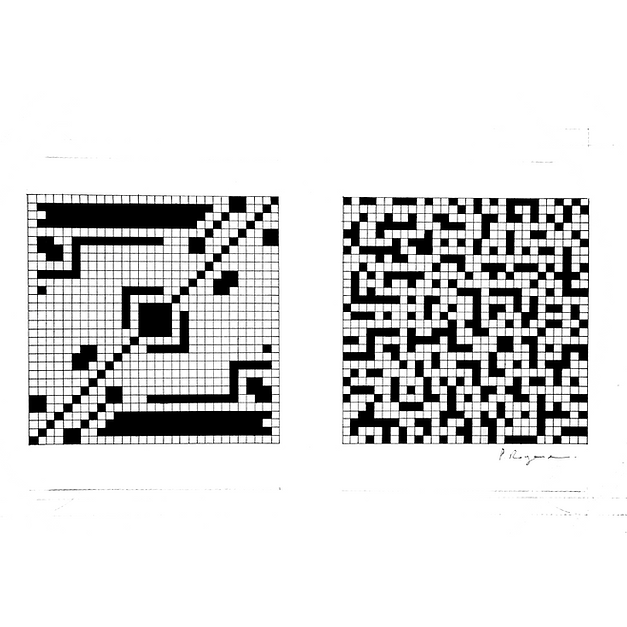
Entropy
Entropy is not what it used to be...
Entropy, in the thermodynamic sense, characterizes the degree of predictability of the information content of a system.
Let's take an ice cube and place it in a room at 30C°. The melting of the ice cube causes a disorganization of the water molecules that compose it. It is almost impossible to predict the future position of these molecules, as the ice cube melts, as well as when it melts completely.
Similarly, let's take the two illustrations opposite. The first one is ordered and organized. Let's then take the same number of black squares that compose it and mix them together to obtain a new illustration. The chances of obtaining the same ones are very low. By evolving over time, it increases its entropy.
Ink 30 x 42 cm
Solar System II
Mercury
Venus
The Earth
March
Jupiter
Saturn
Uranus
Neptune
Pluto (1930 - 2006 RIP)
Ink 15 x 21 cm


Exoplanets
Exoplanets are planets located outside the solar system.
Also called extrasolar planets, they only became the subject of in-depth scientific studies from the 19th century.
To date, more than 4,000 exoplanets have been discovered in more than 3,000 exoplanetary systems, with several thousand more awaiting confirmation.
Physicists, based on extensive observations and numerous discoveries, estimate that there are more than 100 billion of them in our galaxy, the Milky Way, alone.
Ink 30 x 42 cm
Black Hole - Landing
There is, less than a billion light years from Earth, a system of three colliding galaxies. At the heart of each of these galaxies, a supermassive black hole.
This system, also known by the more "accessible" name of SDSS J084905.05 + 111447.2, is a major step forward in the search for triple systems of active supermassive black holes. We also note the presence of what looks like a white hole... Pure artistic speculation.
On approach, a ship tries to collect information on this system still too little known to humans. Landing imminent.
Ink 30 x 42 cm


Psychedelic Trip
Some stages of psychedelic trips:
- Visual improvements
- Increased creativity
- Visible hallucinations
- Dissociation between mind and body
- Total illumination
Acrylic 30 x 42 cm
Positive Negative
Positive Negative ... Negative Positive Negative Positive Negative Positive Negative Positive Negative Positive Negative Positive Negative Positive Negative Positive Negative Positive Negative Positive Negative Positive Negative
Ink 30 x 42 cm


Cosmic Trip I
First realization of a planetary system.
Planets, satellites, comets and other celestial bodies orbiting a star.
Example: the solar system.
The first extrasolar planetary system discovered was that of the star 51 Pegasi , discovered in 1995.
Generally formed around a star, sometimes a pulsar or a red or brown dwarf, the majority of observed planetary systems only contain one planet.
Cosmic Trip is therefore part of the rare lineage of planetary systems with several planets.
Ink 30 x 42 cm
Labyrinth
Lost in the meanders of scientific unknowns...
Ink 30 x 42 cm


Cosmic Dawn
The cosmic dawn puts an end to the "dark ages" of the universe and offers a phase of reionization of atoms, thanks to the radiation of the very first population III stars, one of the first generations of stars having "illuminated" the universe.
The large mass of these stars allowed radiation to reach a high enough temperature to re-ionize the surrounding interstellar medium.
This period of re-ionization extends from 400 million to 1 billion years after the Big Bang.
Ink 30 x 42 cm
Cosmic Trip III
It is possible that somewhere in the universe, such a planetary system exists. By the number, size or shape of these planets, it is a reality...
Ink 21 x 30 cm


Printed Circuit Board
AC/DC
Ink 30 x 42 cm
Radioactive
Radioactivity, discovered by Henri Becquerel in 1896 with uranium, is the transformation of one atom into another atom.
This physical phenomenon is due to the instability of certain atomic nuclei. The latter, containing too many protons or neutrons, sometimes both, must transform in order to return to a stable state. They then release matter (electrons, neutrons, etc.) and energy (photons, etc.) in order to stabilize themselves; this is called disintegration.
Acrylic 50 x 65 cm
